Key Takeaways
Cloud egress fees increase switching costs. Moving large volumes of data out of the cloud can trigger significant charges.
Migration costs go beyond bandwidth. Proprietary formats and complex conversions can require substantial engineering work.
Open standards reduce vendor lock-in. IMAP, EML, CalDAV, and ODF make data easier to access and migrate.
Plan your exit before committing. Check export formats, metadata preservation, migration costs, and contractual terms.
IceWarp supports data portability. Open standards and flexible deployment options help organizations retain control.
What Are Cloud Egress Fees, and Why Do They Matter?
In cloud networking, data transfers fall into two categories:
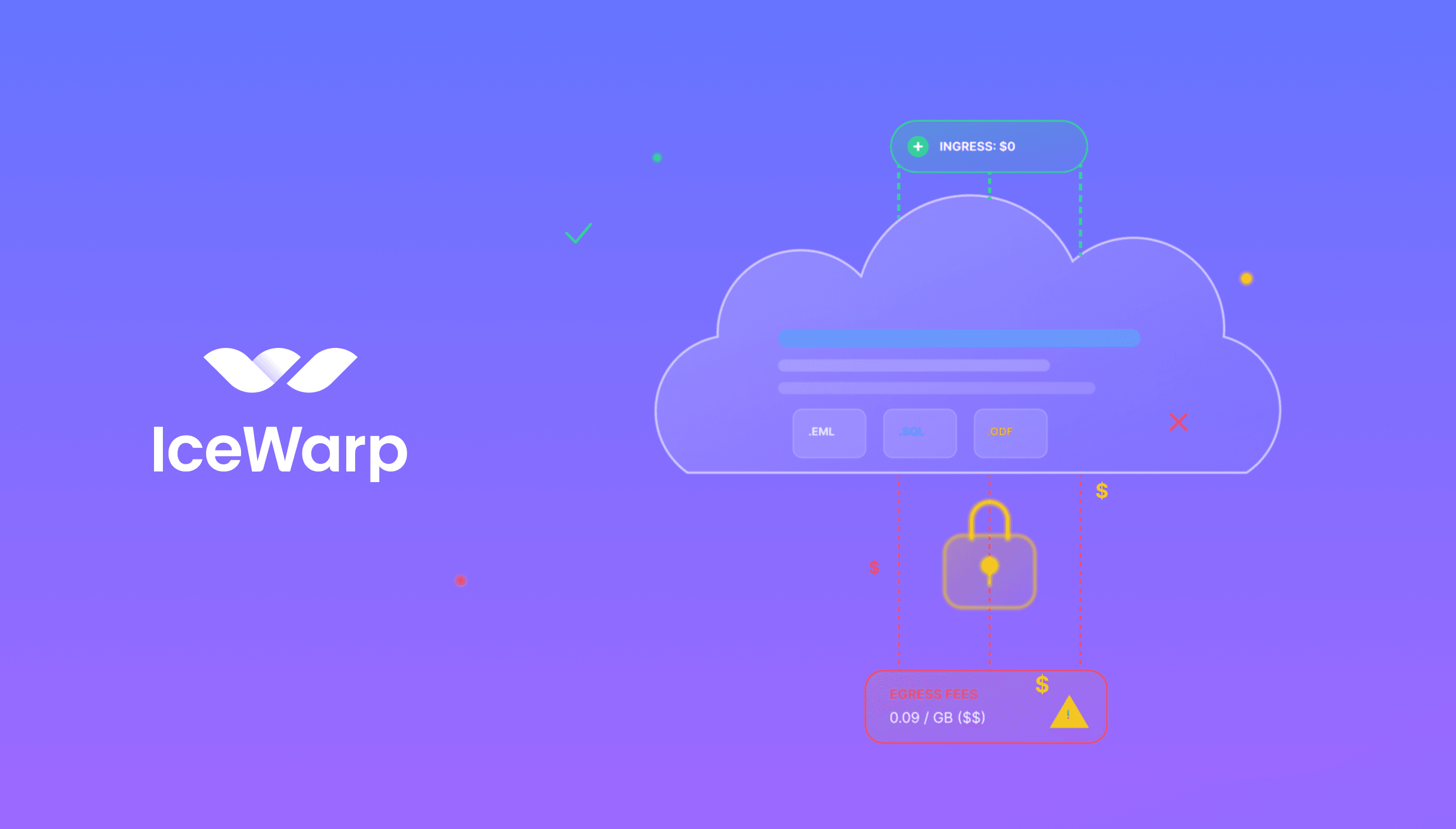
Ingress: Data entering the cloud environment, typically free of charge.
Egress: Data leaving the cloud network, which may incur bandwidth-based charges.
Egress fees vary by provider, destination, and data volume. For example, transferring 50 TB of email archives, business documents, and backups at an illustrative rate of $0.09 per GB would cost approximately $4,500 in bandwidth charges alone.
These costs can reinforce vendor lock-in, making it less attractive to switch providers even when competitors offer better pricing or capabilities.
Regulators are addressing the issue. The EU Data Act is phasing out certain cloud switching charges, while major providers have introduced free data transfers for qualifying migrations. However, eliminating bandwidth fees doesn't necessarily make leaving a cloud platform free.
The Hidden Cost of Proprietary Data Formats
Network transfer charges are only the visible part of cloud migration costs. The bigger challenge is often extracting data in a format another system can actually use.
Many enterprise platforms rely on proprietary databases, APIs, metadata structures, and application-specific features. While they may offer export functionality, the resulting data isn't always immediately compatible with competing platforms.
Consider an organization migrating years of business communication and collaboration data:
Email & chat: Messages require additional processing to preserve attachments, folder structures, and conversation histories.
Documents: Exported files can lose sharing permissions, revision histories, or other platform-specific metadata.
Calendars & contacts: Recurring events, shared calendars, and custom fields need conversion or additional mapping.
Converting the proprietary structures requires custom extraction scripts, database mapping, rebuilt integrations, and extensive validation testing. Even when transferring the data itself costs nothing, making it usable elsewhere can be expensive.
These engineering costs can outweigh bandwidth fees, turning vendor lock-in from a financial concern into a technical dependency. This is why data portability starts with the formats and standards a platform supports.
Why Open Standards Are a Non-Negotiable IT Requirement
The most effective way to reduce technical lock-in is to prioritize interoperability from the beginning. Open standards allow different systems to exchange and interpret information without relying entirely on proprietary tools or vendor-specific conversion processes.
For enterprise communication and collaboration, several standards are particularly important:
IMAP and EML: Provide standardized mailbox access and portable storage of individual email messages.
vCard and CardDAV: Enable standardized contact exchange and synchronization.
iCalendar (ICS) and CalDAV: Support calendar data exchange and synchronization across platforms.
OpenDocument Format (ODF) and Office Open XML (OOXML): Improve document compatibility and editability across office applications.
These standards don't guarantee that every migration will be effortless, as platform-specific features, permissions, and metadata may still require additional work. But they provide a common foundation that reduces unnecessary dependencies.
That’s why an export button isn't enough. Business-critical data needs to be available in documented, usable formats, with enough metadata to migrate it to another platform.
How IceWarp Keeps Your Data Portable
Data ownership and freedom of choice are central to IceWarp's approach to enterprise collaboration. Organizations should stay with a provider because its platform delivers value, not because leaving is too complicated or expensive.
Our approach rests on three principles:
Open standards: Support for established communication protocols and portable data formats, including IMAP for email, EML for message exports, and widely supported formats for contacts and calendars. This helps organizations retain control over their business information without relying entirely on proprietary migration tools.
Zero exit penalties: No hidden exit fees or artificial data extraction penalties, allowing organizations to move their business data without unnecessary financial barriers.
Deployment flexibility: Support for public cloud, private cloud, on-premises, and hybrid environments, allowing organizations to choose and adapt their infrastructure as business requirements evolve.
Before You Choose a Cloud Provider, Plan Your Exit
Before committing to a cloud platform, IT decision-makers should ask five questions:
What will extraction cost? Are there bandwidth charges, termination fees, or additional migration costs? Which export formats are supported? Can business-critical data be retrieved in standard, usable formats? Will metadata survive? Can folder structures, permissions, and other essential information be preserved? Can we export independently? Are standard tools sufficient, or will we need proprietary converters and paid migration services? What does the contract say? Are there restrictions, throttling limits, or additional charges associated with leaving?
The easier these questions are to answer before signing, the fewer surprises you're likely to face when it's time to move on.
Freedom Is an Architectural Feature
Data portability should be evaluated before committing to a provider, not when you're already planning a migration. Open standards, transparent export capabilities, and flexible deployment options help organizations retain control over their information.
With IceWarp, businesses can bring their essential communication and collaboration tools together without sacrificing the freedom to choose how and where they operate.
Frequently Asked Questions (FAQ)
What are cloud egress fees?
Cloud egress fees are charges for transferring data out of a cloud environment. They typically depend on the volume of data transferred, its destination, and the provider's pricing model.
Why is moving data out of the cloud expensive?
Beyond bandwidth charges, migrations may require converting proprietary formats, preserving metadata, rebuilding integrations, and validating data integrity.
How can businesses avoid cloud vendor lock-in?
Prioritize providers that support open standards, offer documented data export capabilities, and provide flexible deployment options. Review migration costs and contractual terms before committing.
Which open standards support data portability?
Common standards include IMAP and EML for email, vCard and CardDAV for contacts, ICS and CalDAV for calendars, and ODF or OOXML for documents.
How does IceWarp support data portability?
IceWarp supports standard communication protocols, portable data formats, and public cloud, private cloud, on-premises, and hybrid deployments, helping organizations retain control over their data and infrastructure.